Spin Dinero Reviews and Complaints: What Player Feedback Can and Cannot Prove
 Available in US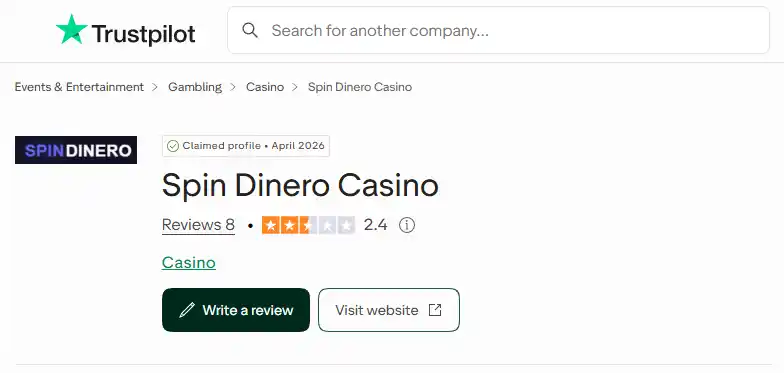
Public feedback on Spin Dinero is poor overall on Trustpilot, but the sample is small and the individual posts are user reports rather than adjudicated findings. The Australian Trustpilot profile shows a 2.5 out of 5 TrustScore from seven reviews, with most ratings at one star. Recurring complaints concern withdrawals, verification, bonus conditions and support, while one Australian reviewer reports successful payouts when following the rules. The useful way to read that mix is to treat it as a signal about where players experience friction, then compare those themes with Spin Dinero’s published terms.
That cross-check matters because a complaint can describe a real experience without proving fraud, theft or deliberate non-payment. Spin Dinero’s own terms confirm that withdrawals are subject to verification, a review stage and a separate processing stage, and they publish a minimum withdrawal. Those contractual facts do not prove that every complaint is justified, but they help explain which parts of a review can be independently checked. For the detailed rules, see the Spin Dinero withdrawal guide.
Table of Contents
- What the Trustpilot profile shows
- Withdrawal complaints are the strongest recurring theme
- KYC complaints need the same cross-check
- Bonus disputes are often rule disputes
- One positive review changes the picture, but not the sample problem
- What review platforms can tell you
- What review platforms cannot prove
- How to use complaints before making a decision
- A balanced reading of the reputation signal
- Questions about Spin Dinero reviews
- Recommend
What the Trustpilot profile shows
The Australian Trustpilot page for Spin Dinero shows seven reviews and a TrustScore of 2.5 out of 5. The visible distribution is heavily negative, with six of the seven reviews at one star and one at five stars. That is a poor aggregate signal, but it is also a very small dataset.
Small samples are fragile. One new positive or negative review can move the apparent balance substantially, and the people who choose to post on a review platform are not necessarily representative of the full player population. The profile is therefore useful for identifying themes, not for estimating a reliable percentage of all Spin Dinero customers who are satisfied or dissatisfied.
Trustpilot also states that reviews belong to their authors and that the platform uses systems intended to detect fake reviews. Those controls are relevant, but they do not transform each review into a verified account of what happened between a player and the casino.
Withdrawal complaints are the strongest recurring theme
Several one-star reviews allege that withdrawals were denied, cancelled or reduced after approval or after additional conditions were applied. These are serious claims from the reviewers, but they remain allegations. The platform evidence by itself cannot establish whether a casino breached its terms in any specific case.
What can be checked is the baseline withdrawal framework. Spin Dinero’s published terms state that account verification is required before withdrawal. The official minimum withdrawal is A$100. The terms also set a withdrawal-review period of up to five business days and then a separate processing period of 10 business days after approval.
This does not validate a complaint, but it provides a useful diagnostic lens. A reviewer who expected an instant payout may be describing dissatisfaction with a published process rather than an undisclosed delay. By contrast, a claim that an already approved request was later cancelled raises a different question and cannot be resolved from the platform post alone.
The separate withdrawal limits and times page goes into those published stages in detail so that review-platform anecdotes are not used as a substitute for the casino’s own rules.
KYC complaints need the same cross-check
Verification is another repeated point of friction in the review sample. One reviewer describes being asked to verify identity and then a crypto account. Other complaints connect withdrawal problems to verification requirements.
The independently verifiable part is narrower. Spin Dinero’s terms require account verification before withdrawal and explicitly list a government-issued photo ID plus proof of address as the core documents. The terms also allow additional information to be requested when needed to validate an account.
What the terms do not support is a blanket claim that every extra verification request is improper. Nor do they prove that every request described by a reviewer was handled correctly. A public review normally lacks the complete account history, document quality, payment trail and internal reason for a decision. That missing context is why the Spin Dinero registration and KYC guide separates the documented KYC baseline from case-specific claims.
Bonus disputes are often rule disputes
Some criticism focuses on promotional offers, playthrough conditions and the interaction between bonus money and withdrawals. This category is especially easy to misread because different Spin Dinero promotions can have different offer structures and conditions.
A reviewer may accurately report that a promotion felt misleading while still omitting the exact bonus code, wagering status, deposit sequence or maximum cashout rule that applied to that account. Conversely, the existence of written terms does not prove that a promotion was explained clearly to a player. Both possibilities can exist without the review platform being able to adjudicate the dispute.
The practical response is to identify the exact promotion first, then read the applicable conditions before depositing or withdrawing. The current Spin Dinero promotions page keeps live promotional offers separate from older or broader bonus terms so that one set of conditions is not casually applied to every offer.
One positive review changes the picture, but not the sample problem
The profile is not uniformly negative. One Australian reviewer gives Spin Dinero five stars and says that payouts have worked when the rules were followed, while also praising customer support. That report is useful because it shows the public feedback is not a single-direction narrative.
It should be treated with the same caution as the negative reviews. A positive experience does not prove that withdrawals always succeed, just as a negative experience does not prove systematic wrongdoing. The value lies in comparing reports with different outcomes and looking for the process variables that might explain the difference.
In this sample, the recurring variables are verification, withdrawal rules, bonus conditions and support interactions. Those are the areas worth checking before playing because they have both public-feedback visibility and published contractual rules.
What review platforms can tell you
Review sites are strongest at showing patterns of friction. If several people independently complain about the same stage – for example KYC or cashout – that tells a prospective user where to read the terms carefully and what records to keep. It may also reveal usability problems that a formal terms page will never describe, such as confusing communication or expectations created by promotional messaging.
They are also useful for recency. A review can flag that a problem or improvement is being discussed now rather than years ago. This is why the date and size of the sample matter more than a timeless label such as “trusted” or “scam”.
Finally, public reviews expose disagreement. A mixed set of reports reminds readers that individual outcomes vary and that a single anecdote cannot substitute for a documented rule or a regulator finding.
What review platforms cannot prove
A review platform cannot normally prove fraud, theft, deliberate non-payment, regulatory status or the legal outcome of a dispute. Those findings require stronger evidence: account records, operator correspondence, payment records, regulator decisions or court findings.
It also cannot prove that a casino is licensed in Australia. That question belongs to ACMA’s register and the legal framework discussed on the Spin Dinero licensing and trust page. Mixing reputation and regulation is a common mistake because both are often placed under a generic “trust” heading, but they answer different questions.
Nor should seven reviews be treated as a statistical sample of all customers. The profile gives a snapshot of visible feedback, not a representative survey.
How to use complaints before making a decision
The most useful approach is to convert complaint themes into a checklist. For withdrawals, understand the minimum amount, verification requirement, review period and processing stage before requesting funds. For KYC, make sure account details match the identification and address evidence the terms require. For bonuses, identify the exact offer and conditions rather than assuming all promotions share one rule set.
Keep records as well. Saved copies of the offer used, the relevant terms, payment confirmations and support conversations can provide context that a later public review cannot recreate. That does not guarantee a favourable dispute outcome, but it gives a clearer factual record if something needs to be escalated.
For Australian readers, regulatory context should be checked separately. Spin Dinero is not listed in ACMA’s register of licensed interactive gambling providers, and online casino-style services are prohibited from being supplied to customers in Australia. That issue is independent of whether a Trustpilot reviewer had a positive or negative personal experience.
A balanced reading of the reputation signal
The Spin Dinero review profile is plainly negative in aggregate, with a small sample dominated by one-star reports. Withdrawal and verification complaints appear often enough to deserve attention, while the presence of a positive payout report shows that the visible experiences are not identical.
The most defensible reading is therefore limited but useful: public feedback identifies cashout, KYC, bonus conditions and support as friction points worth checking in advance. It does not prove a universal outcome, misconduct in every disputed case or a definitive legal status.
That distinction produces a more useful reputation assessment than simply repeating the harshest review. Read the complaints for patterns, read the official terms for rules, and read the trust and regulation page for the Australian legal and licensing position. The Spin Dinero Australia review provides the wider product context without treating reputation as a substitute for verified facts.
Questions about Spin Dinero reviews
What is Spin Dinero’s Trustpilot score?
The Australian Trustpilot profile shows a TrustScore of 2.5 out of 5 from seven reviews. Because the sample is small, the score should be treated as a reputation signal rather than a representative customer-satisfaction measure.
What do most complaints discuss?
Negative posts frequently discuss withdrawals, verification, bonus conditions and support. These are reviewer allegations and experiences, not adjudicated findings.
Do complaints prove Spin Dinero refuses to pay?
No. Public complaints can identify patterns worth investigating, but they do not by themselves prove deliberate non-payment, fraud or theft in a specific case.
Are KYC requirements independently confirmed?
Yes. Spin Dinero’s published terms require verification before withdrawal and list government-issued photo ID and proof of address as core evidence.
Should reviews be used to decide whether Spin Dinero is legal in Australia?
No. Australian licensing and legal status should be checked against ACMA and primary legal sources, not review-platform sentiment.