Is Spin Dinero Legit in Australia? ACMA, Licensing and Player Protection
 Available in US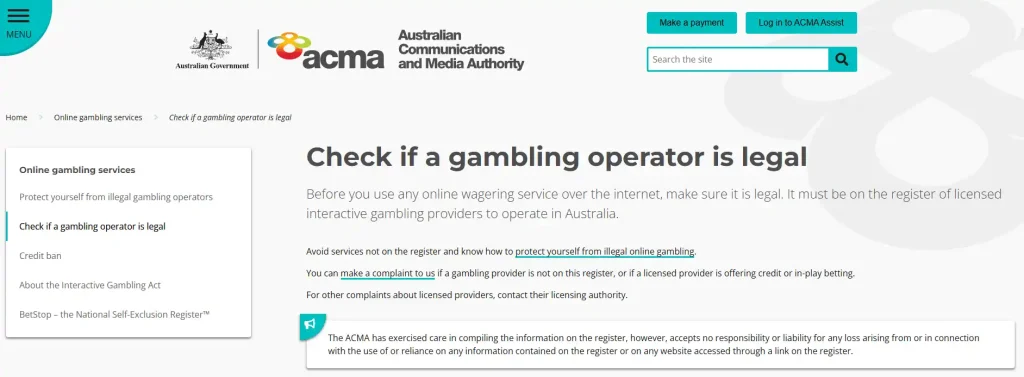
Spin Dinero is not listed in the Australian Communications and Media Authority’s register of licensed interactive gambling providers. That matters because Australia regulates online gambling primarily from the provider side: the Interactive Gambling Act 2001 prohibits providers from offering online casino-style services to customers in Australia. Spin Dinero should therefore not be described as Australian-licensed, ACMA-approved or fully legal in Australia. At the same time, absence from the ACMA register is not proof that the brand itself refuses every Australian account, and it does not establish a separate criminal offence for an Australian player simply for accessing a site.
The practical trust question is wider than a yes-or-no label. It involves four separate issues: local licensing, the federal prohibition on supplying online casino services, the protections available if something goes wrong, and the unresolved offshore operator or licence claims attached to the brand. Those issues should be kept separate from whether the site can technically be reached or whether an account can be created. For banking mechanics, see Spin Dinero payment methods; for payout rules, use the Spin Dinero withdrawal guide.
Table of Contents
- The clearest verified point: no ACMA register entry
- What Australian law says about online casino services
- Operational access is not the same as Australian authorisation
- Offshore licence and operator claims remain unresolved
- What protection does an Australian player actually have?
- The dispute route named in Spin Dinero’s own terms
- BetStop does not cover offshore online casino games
- Website blocking is an enforcement tool, not a licence test by itself
- Australian rules and reforms starting in 2027
- A practical trust test for Spin Dinero
- What to do if a dispute develops
- Questions about Spin Dinero’s Australian status
- Is Spin Dinero Legit in Australia? ACMA, Licensing and Player Protection
The clearest verified point: no ACMA register entry
ACMA maintains a public register of licensed interactive gambling providers. A check of that register did not find Spin Dinero. This means there is no basis for saying that Spin Dinero holds an Australian interactive wagering licence or that it receives the protections associated with a listing on that register.
Terms such as “licensed”, “regulated” or “legal” are incomplete unless the jurisdiction is specified. For an Australian reader, the relevant local question is narrower: is the provider listed by the Australian regulator? For Spin Dinero, the answer is no.
The register establishes that no Australian licensed-provider entry is shown for Spin Dinero. It does not, by itself, identify the exact corporate entity operating the casino, prove or disprove every overseas licence claim, or establish whether a particular Australian visitor can reach the site at a given moment.
What Australian law says about online casino services
ACMA’s guidance states that the Interactive Gambling Act 2001 makes it illegal for gambling providers to offer certain online services to people in Australia, including online casinos. The federal legislation works around an “Australian-customer link”: where a prohibited interactive gambling service is supplied to customers physically present in Australia, the provider can fall within the federal prohibition.
This provider-side framing matters. It is accurate to say that online casino-style services cannot legally be provided to customers in Australia. It is not accurate to turn that into a sweeping claim that every Australian player commits an offence merely by visiting or playing on an offshore casino. Australian guidance on provider restrictions should not be expanded into a broader player-liability claim without a specific legal basis.
ACMA also says prohibited services must not be advertised in Australia. Its enforcement work includes formal warnings, investigations and requests for internet service providers to block illegal gambling websites. These measures show that the Australian system is active, but they should not be converted into a claim that every unlisted casino has already been individually investigated or blocked.
Operational access is not the same as Australian authorisation
A common source of confusion is the assumption that if a site loads, accepts an account or displays Australian dollars, it must be authorised for the Australian market. Those are different questions. Technical access describes what a user can reach. Currency support describes how a casino processes balances. Australian authorisation depends on the local regulatory framework and, for licensed wagering services, the ACMA register.
AUD support, registration flow and payment options cannot be used as evidence of an Australian licence. Likewise, the fact that Spin Dinero may be operationally accessible to some Australians does not override the provider-side restrictions in the Interactive Gambling Act.
The reverse is also true: absence from the licensed-provider register does not automatically prove that Spin Dinero has implemented a universal block against every Australian account. That would require direct evidence of a brand-wide general restriction, not an inference from licensing status. Keeping these dimensions separate avoids both promotional overstatement and regulatory overstatement.
Offshore licence and operator claims remain unresolved
Public information about Spin Dinero’s offshore operator and licensing position is inconsistent. Without a single directly verified identity and licence record, an exact offshore licence number, expiry date or corporate operator name should not be treated as confirmed.
An offshore licence claim is not interchangeable with an Australian licence, and a disputed corporate identity should not be treated as settled. Until a regulator record or clearly attributable official licence page resolves the conflict, the Australian register does not list Spin Dinero and the separate offshore details remain unresolved.
For a user assessing trust, this matters because a licence is valuable only if its jurisdiction, operator and complaint route can be identified with enough certainty to know what the regulator can actually do. A vague “licensed casino” label provides much less practical information than a verified register entry.
What protection does an Australian player actually have?
Australian-licensed wagering providers operate within a framework that includes local licensing authorities, ACMA oversight and national harm-minimisation measures. Spin Dinero’s absence from the ACMA register means those same Australian protections should not be assumed to apply to a Spin Dinero account.
ACMA advises consumers to use legal gambling services and warns that illegal services may not provide the same customer protections. That warning is especially relevant to disputes involving account balances, withdrawals or verification because practical recovery options can be more limited when the operator is outside the local licensing framework.
The appropriate response is not to claim that a dispute is unwinnable. It is to recognise that the available escalation route may be different and that Australian regulator mechanisms designed for licensed providers should not be assumed to cover an offshore casino.
The dispute route named in Spin Dinero’s own terms
Spin Dinero’s published terms refer game disputes to RTG’s Central Dispute System, commonly abbreviated CDS. This is the specific route named in the casino’s terms; they do not identify a generic ombudsman or Australian complaint body for that purpose.
The scope is important. A game dispute route is not automatically a substitute for an Australian gambling regulator, financial ombudsman or court. It is a process linked to the game platform and the casino’s terms. Readers should therefore understand it as one available escalation channel for the disputes described by those terms, not as proof of Australian regulatory coverage.
If the issue is a withdrawal rather than a game result, first compare the account against the casino’s published payout and KYC rules. Spin Dinero’s terms require verification before withdrawal and set separate review and processing stages. Those rules are explained in the cashout rules and account verification pages so that a contractual delay is not confused with a regulator decision.
BetStop does not cover offshore online casino games
BetStop is Australia’s National Self-Exclusion Register, but its scope is licensed online and phone wagering providers. The official BetStop material explicitly distinguishes that system from online casino games and other gambling services that are illegally provided in Australia.
That means it would be misleading to tell a Spin Dinero user that joining BetStop will automatically close or block an offshore online casino account. BetStop is an important national tool, but it operates within the licensed wagering environment. Its scope should not be expanded by implication.
For someone who wants to reduce access to offshore casino sites, practical controls may need to include device or browser blocking, payment controls and support from independent gambling-help services in addition to any national self-exclusion tools that apply to licensed wagering.
Website blocking is an enforcement tool, not a licence test by itself
ACMA regularly asks Australian ISPs to block websites that investigations find to be operating in breach of the Interactive Gambling Act. Casino-style services make up a significant part of those enforcement lists. A blocked domain can therefore be a strong sign of an ACMA enforcement action against that specific site.
However, the absence of a domain from a published blocking list is not equivalent to approval. Enforcement lists are not a whitelist, and a casino does not become locally licensed simply because its name is missing from a particular quarterly action report. The more direct licensing test remains the ACMA register.
This distinction is especially useful for brands that use multiple domains or change domains over time. A domain-specific block and a provider’s licensing status answer different questions.
Australian rules and reforms starting in 2027
Australia has passed additional gambling reforms, and ACMA says most of the new measures commence on 1 January 2027. Until those measures commence, they should not be described as operative requirements.
The applicable framework includes the Interactive Gambling Act, ACMA enforcement and the licensed-provider register. Scheduled reforms can change compliance obligations or consumer-protection arrangements, but they do not retroactively give Spin Dinero an Australian licence or alter the register result.
Separating operative law from scheduled commencement dates is more than a technicality. It prevents a reader from assuming that a protection or restriction scheduled for 2027 applies before its commencement date.
A practical trust test for Spin Dinero
A generic “safe” or “unsafe” badge hides the more useful details. Spin Dinero is not on ACMA’s licensed-provider register; Australian law prohibits providers from offering online casino-style services to customers in Australia; the casino’s exact offshore licence and operator identity remain unresolved; and its own terms name RTG’s Central Dispute System for game disputes, which is not Australian regulatory protection.
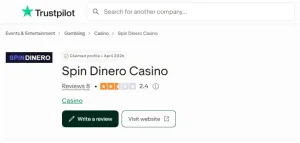
Those details give an Australian reader a clearer basis for a decision than a generic legitimacy score. The Spin Dinero reviews and complaints section can show recurring reputation issues, but licensing and legal status should be checked against the relevant regulator and legislation.
What to do if a dispute develops
A useful escalation sequence starts with evidence rather than labels. Keep the withdrawal request status, transaction references, verification requests, bonus terms that applied to the account and the relevant support conversation. Compare the issue against the published terms before treating a delay as a refusal, because Spin Dinero separates account verification, withdrawal review and post-approval processing into different stages.
If the dispute concerns game operation, the Central Dispute System route named in the terms is the specific channel identified by Spin Dinero. If the concern is that an online gambling service is being provided illegally to people in Australia, ACMA provides a complaint route for illegal gambling services. Those are different forms of escalation and should not be presented as interchangeable remedies.
For a broader decision before depositing, the Spin Dinero Australia review brings the regulatory position together with banking, games, bonuses, mobile access and account requirements. Commercial features such as AUD banking or mobile access do not override the Australian legal and licensing context.
Questions about Spin Dinero’s Australian status
Is Spin Dinero licensed by ACMA?
No Spin Dinero entry was found in ACMA’s register of licensed interactive gambling providers, so Australian licensing should not be assumed.
Are online casinos allowed to be provided to Australians?
ACMA states that online casinos are among the services providers are prohibited from offering to people in Australia under the Interactive Gambling Act 2001.
Does that mean an Australian player is committing an offence by playing?
The Australian rules cited above focus on provider-side prohibitions. They do not establish a blanket offence for a player merely accessing or playing on an offshore online casino.
Does BetStop cover Spin Dinero?
BetStop covers licensed online and phone wagering providers and does not extend to illegally provided online casino games.
What dispute route does Spin Dinero publish?
The casino’s terms refer game disputes to RTG’s Central Dispute System. That route should not be confused with Australian regulatory or licensing coverage.