Real-Money Casino Table Games in Australia
 Available in AU
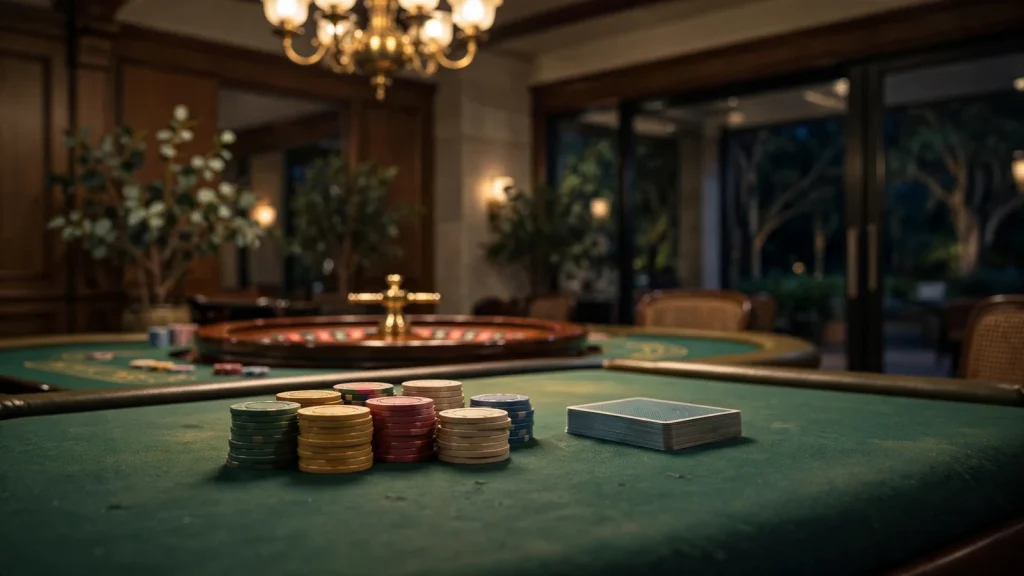
It outlines the legal boundary for online casino games in Australia and explains how live-dealer, card, roulette and poker tables differ.
Table of Contents
- The Australian Boundary Around Online Casino Games
- A Table on Screen: Live Dealers and Random Outcomes
- What the Known Facts Can—and Cannot—Say About Odds
- The Decisions Around a Table
- The Search for a Nearby Table
- What Counts as a Casino Table Game?
- Different Tables, Different Forms of Play
- Card Games and the Bets They Invite
- Roulette’s Two Green Pockets
- Poker as a Contest of Hands
- Casino Games
The Australian Boundary Around Online Casino Games
In Australia, the legal boundary around online casino table games is drawn around the service and the place where it is provided. The Interactive Gambling Act 2001 prohibits operators from offering real-money online casino games to people physically located in Australia. That applies to companies based in Australia and to offshore operators serving customers here. A website’s foreign address does not turn the activity into a lawful exception.
Section 5 of the Act prohibits operators based within Australia from offering real-money interactive casino games to residents. The broader rule reaches online casino-style services provided to people in Australia, including table games. The distinction between a local company and an overseas one matters to how the law describes the provider; it does not create a permitted route for real-money online play within the country.
That boundary can be obscured by the ordinary geography of the internet. A service may be operated abroad, display international branding and appear in English, while its intended customer is sitting in Australia. But the law is not simply a map of where a company has registered itself. Its relevant question is whether prohibited interactive gambling is being provided to people in Australia.
The Australian Communications and Media Authority, or ACMA, enforces compliance with the Act and blocks unlicensed platforms. Enforcement is therefore part of the practical setting, not a footnote to an otherwise open market. The presence of a site, its polished presentation or its ability to load at a particular moment does not establish that its service is lawful. Online access and legal permission are different things.
This matters particularly for searches framed around online casino table games for real money. Such wording describes an activity that Australian law restricts operators from providing to people in the country. The same boundary applies whether the table is presented as a digital game or as a live casino service: the broad legal issue is the provision of real-money online casino gambling, rather than the visual style of the table.
Best 3-Reel Slots in Australia: Features Explained
The distinction also changes how familiar commercial language should be read. A site may speak of international availability, promotions or a range of table games, but those claims do not alter the Australian legal framework. Nor does the word “offshore” mean “outside the law” when the service is being supplied to people in Australia. The location of the operator and the location of the customer are not interchangeable details.
There is a revealing tension here. The internet presents services as if they were placeless, while gambling law assigns responsibility to actual operators and identifies the people to whom a service is offered. Australia’s framework draws that line against real-money online casino provision, even when the company behind a service is based elsewhere. A border may be faint on a screen; it is not absent from the statute.
That is why phrases such as “best online casino table games” or “free table games online casino” do not settle the legal question. They may describe different kinds of browsing or play, but the law’s prohibition concerns real-money interactive casino services. The key distinction is not a promotional label or a game category. It is whether an operator is providing a prohibited service to people in Australia.
The same caution applies to claims about offshore casinos being beyond Australian rules. The Act’s reach is not limited to companies incorporated locally. Offshore status does not make it lawful to provide real-money online casino games to people physically in Australia, and ACMA’s enforcement role forms part of the country’s effort to uphold that boundary. A foreign location is not a legal disguise.
For the Australian market, then, “online” is not a synonym for “available without restriction,” and “international” is not a synonym for “permitted.” The law places the obligation on operators, not on the appearance of a website. Its effect is to prohibit real-money online casino services to people in Australia, while the regulator works to enforce that rule and block unlicensed platforms. The screen may suggest a borderless table. The law does not.
Legal Prohibition
The Interactive Gambling Act 2001 prohibits operators from offering real-money online casino games to people physically located in Australia, regardless of where the operator is based.
A Table on Screen: Live Dealers and Random Outcomes
A table game on a screen can present itself in two quite different ways. In one, a real dealer works with real casino equipment while video of the table is streamed live to players. In the other, software determines the outcome: a random number generator selects the cards dealt or the point at which a roulette ball lands. Both may appear on a screen. The screen is not the source of the outcome in the same way.
The live-dealer format preserves a visible human ritual. A person handles the equipment; the camera carries that activity to remote viewers. It is a mediated table, not a physical one shared by everyone watching. The dealer and equipment are real, while the player’s view arrives as a live video stream. The image supplies a sense of occasion that software alone cannot supply: a human presence, a working surface, an action unfolding in time.
That presence should not be confused with control over the result. A real dealer conducts the game, but the existence of a person at the table does not, by itself, explain or establish the terms on which an outcome is determined. What can be said from the format is narrower: a live dealer uses real casino equipment, and players watch through a stream. The camera makes the encounter visible. It does not turn a remote player into someone seated at the felt.
Mines Casino Game in Australia: What to Know
Software-based play removes that visible dealer from the determining process. A random number generator is used to decide which cards are dealt or where the roulette ball lands. The result is generated by software rather than shown emerging from a physical table in a live stream. The interface may still depict familiar casino equipment, but an image of a table is not proof that a real table is producing the outcome.
This difference is about presentation and mechanism, not a ranking. A live stream may look more like a conventional casino scene; an automated version may make the software’s role more central. Neither description, on its own, establishes which format is more favourable, more reliable, or better suited to a particular player. Those are separate claims, and the appearance of human activity cannot settle them.
The distinction also makes sense of searches that pair table games with Bitcoin or other payment language. A payment method concerns how money is moved; it does not change whether a dealer is handling real equipment on camera or software is selecting the result. A table cannot become live because a payment is digital. Nor does a software-generated game acquire a physical dealer merely because its graphics borrow the look of a casino.
That separation is easy to blur. Digital interfaces are designed to make unlike processes look familiar: a felt surface, cards, a wheel, a dealer framed by a camera. Yet what is shown and what determines the outcome are different questions. In one format, the stream shows a real dealer and equipment in use. In the other, the determining step belongs to a random number generator, even when the screen borrows the visual language of a table.
Live Dealer
A real dealer uses physical casino equipment, and the action is streamed via live video to the player.
Software-Based
A random number generator (RNG) determines the outcome, which is then presented through a digital interface.
The difference is therefore not simply old against new, or human against machine. The live format brings a person and physical equipment into the visible scene; the software version makes an algorithmic selection the operative event. Each asks the viewer to understand a screen differently. One is a window onto a streamed table. The other is a visual interface for an outcome generated in software. The resemblance ends there.
What the Known Facts Can—and Cannot—Say About Odds
The phrase “best odds” sounds like a property stamped on a game, as though a table carried a small brass label announcing its generosity. It does not. A comparison needs more than the name of a game: it needs the rules in force, the available wagers and the payouts attached to possible outcomes. Without those particulars, a ranking is decoration dressed as arithmetic.
Odds describe the likelihood of an outcome; a payout describes what follows if it occurs. The house edge is a way of expressing the mathematical advantage built into a game over repeated play. These ideas are related, but they are not interchangeable. A wager that appears to win frequently may pay less when it does, while a rarer outcome may carry a larger payout. Counting wins alone cannot settle which arrangement is more favourable.
That is why a casino table games house edge chart is useful only when its entries share a sound basis for comparison. The game’s name is not enough. Rules and payout terms can differ between versions, and a chart that leaves those conditions unstated may place unlike things side by side. Its neat columns can make uncertainty look resolved. Neat columns have their uses.
The familiar question—what casino table games have the best odds?—therefore has no responsible universal answer on mechanics alone. Nor does the opposite label, “worst odds”, become reliable merely because it is less flattering. Both claims require comparable calculations, made under specified conditions. A list that names a winner without showing what was measured is not an odds analysis; it is an assertion wearing a tablecloth.
Crash Casino Games in Australia: Rules and Risks
There is a further distinction between a game’s underlying mathematics and the way a particular round unfolds. In a software-based version, an RNG determines the relevant outcome; in a live-dealer version, real equipment and a streamed table present the action. The presentation differs, but neither label, by itself, supplies a comparative return percentage. A camera can make the event feel immediate. It cannot make a missing calculation appear.
The useful discipline is to separate what can be observed from what would need to be calculated. Rules describe how a game proceeds. Payout terms describe what a winning wager receives. A comparative odds claim needs both, applied consistently. Familiarity, pace and the visual drama of a table may shape how people experience a game, but they do not establish its mathematical advantage.
This restraint is less exciting than a podium of “best” and “worst” tables. It is also more honest. A game cannot be crowned on atmosphere, reputation or a bare title; a ranking needs the working beneath it. Where the conditions are not stated, confidence is not a substitute for evidence.
High-Volatility Slots in Australia: What to Know
The Decisions Around a Table
Blackjack is organised around a simple opposition: one player’s hand against the dealer’s. The aim is to finish with a value closer to 21 than the dealer’s hand. That premise gives the game its particular tension. Unlike a contest in which players compare their hands with one another, the table keeps returning attention to a single figure on the other side: the dealer’s total.
The structure is easy to grasp even before the details of play are learned. There is a hand to build, a target value to approach, and an opponent whose result matters more than anyone else’s. The player is not trying to collect the grandest-looking cards or to defeat every person seated nearby. The contest is narrower, and that narrowness is part of its appeal.
A casino table can make this arrangement feel almost theatrical. The dealer occupies a visible role, handling the shared ritual of the game, while each player’s decisions remain individual. Several people may sit at the same table, but the central comparison is still between each hand and the dealer’s. The table gathers a small public around a private calculation.
That distinction helps explain why blackjack often appears among the popular casino table games. Its premise can be stated without a long preface: get closer to 21 than the dealer. The simplicity is not the same as a complete account of how to play. It is the frame within which the more detailed decisions take place.
Best Bonus Buy Slots in Australia: Rules and RTP
The number at the centre of the contest also gives the game a clear boundary. A hand is judged not in isolation, but in relation to the dealer’s hand and the shared target. This makes each turn legible to the people around the table. A player’s choices may be personal, but their consequence is public: the hand moves towards or away from the number that defines the contest.
There is a social history in that arrangement, even when the table is quiet. The dealer is not merely another competitor; the role represents the house’s side of the encounter. Players face the institution through one person and one hand. The ritual makes a commercial contest look intimate, almost domestic: cards, a felt surface, a measured comparison. The house is present, but in human form.
For anyone trying to learn how to play casino table games, blackjack offers an especially clear example of the player-versus-dealer design. Its basic shape is not a catalogue of moves but a relationship: a hand, a target, and the dealer’s competing result. That is enough to understand what the game is asking of its participants, without mistaking the outline for a full rules guide.
The attraction lies partly in the balance between clarity and uncertainty. The objective is plain; the outcome is not. That combination gives the table its rhythm, as players watch their own position develop against the dealer’s rather than against an abstract score alone. A spare design. A human opponent.
The Search for a Nearby Table
A request for a casino close by sounds simple: find a place, establish the distance, and learn whether it has table games. But “nearby” is not a fixed point on a map. It depends on where someone starts, how they travel and what they mean by close. A venue that looks near in a straight line may be less convenient than one farther away by road or public transport.
Lightning Link Online Pokies in Australia: What to Know
The wording also carries an expectation about the place itself. A search for a nearby table is not necessarily a search for a particular game or a lesson in its rules. It may mean a physical room, equipment, other players and a dealer sharing the same space. That is a different idea from seeing a table represented on a screen. The distinction matters because a place-based request cannot be answered by treating every online result as a local destination.
Australia’s legal setting gives that distinction particular weight. The Interactive Gambling Act 2001 prohibits operators from providing real-money online casino games to people in Australia. Casino-style games such as blackjack, roulette and poker fall within that restriction when offered as online services. ACMA is responsible for enforcing the rules and blocks unlicensed domestic platforms. A physical-location search and an online-casino search therefore do not describe interchangeable ways to reach the same table.
A phrase such as “the closest casino with table games” also leaves several details unstated. Closest by what measure: distance, journey time or ease of access? And what counts as a table-game offering: a particular game, a particular kind of table, or simply the presence of tables? Without those particulars, a confident comparison would be more theatrical than useful. A map can measure distance. It cannot, by itself, settle what a venue offers or whether that offering suits the purpose of the search.
The same caution applies when the wording names a city outside Australia. A place name in a search phrase does not establish that the person is there, or that a result belongs in an Australian account of casino venues. The market matters. So does the difference between a location and a service delivered across a screen.
There is a small social history in the desire for a nearby table. Table play has traditionally depended on shared space: a surface, a set of rules, and people gathered around an outcome. The search for proximity is therefore not merely about convenience. It points to a kind of encounter, one that cannot be inferred from a game title alone.
That leaves a plain distinction. A nearby physical venue is a question of place; an online casino is a question of a service governed by Australian law. Conflating them makes a location search sound more answerable than it is. Distance is only the beginning.
What Counts as a Casino Table Game?
Choosing a real-money casino for table games in Australia calls for checking the available operator information before deciding where to play. These brief verdicts highlight the details provided for each operator.
1. Rollero Casino
License: Curacao Gaming Control Board OGL/2023/176/0095 (Hollycorn N.V.)
Rollero Casino is listed with a Curacao Gaming Control Board licence, OGL/2023/176/0095, held by Hollycorn N.V.
2. WinSpirit Casino
License: Curacao eGaming OGL/2024/923/0383 (Antillephone N.V.) · Min. deposit: A$30
WinSpirit Casino is listed with a Curacao eGaming licence, OGL/2024/923/0383, held by Antillephone N.V. Its minimum deposit is A$30.
3. Playfina Casino
License: Curacao eGaming (Hollycorn N.V., since 2017) · Min. deposit: A$20-30 (depends on the offer)
Playfina Casino is listed as operating under a Curacao eGaming licence held by Hollycorn N.V. since 2017. The stated minimum deposit is A$20–30, depending on the offer.
4. Thor Casino
License: Curacao – Antillephone N.V. (Versus Odds B.V.) · Min. deposit: EUR 20
Thor Casino is associated with a Curacao licence from Antillephone N.V. for Versus Odds B.V. Its minimum deposit is EUR 20.
5. LevelUp Casino
License: Curacao eGaming OGL/2023/174/0082 (Dama N.V.) · Min. deposit: A$15
LevelUp Casino is listed with a Curacao eGaming licence, OGL/2023/174/0082, held by Dama N.V. Its minimum deposit is A$15.
6. Bizzo Casino
License: Curacao Gaming Control Board (TechSolutions Group N.V.)
Bizzo Casino is listed with a Curacao Gaming Control Board licence held by TechSolutions Group N.V.
7. Lucky Dreams
License: Curacao · Min. deposit: A$20 (POLi)
Lucky Dreams is listed with a Curacao licence. Its stated minimum deposit is A$20 when using POLi.
8. SpinsUp
License: Curacao Gaming Control Board OGL/2023/174/0082 (Dama N.V.)
SpinsUp is listed with a Curacao Gaming Control Board licence, OGL/2023/174/0082, held by Dama N.V.
9. Ricky Casino
Payout speed: crypto under 1 hour, PayID 1-3 business days · Min. deposit: A$20 (A$30 to qualify for the bonus)
Ricky Casino lists crypto payouts as taking under an hour and PayID payouts as taking 1–3 business days. The minimum deposit is A$20, or A$30 to qualify for the bonus.
10. House of Pokies
License: international iGaming licence – jurisdiction not named in the source · Payout speed: PayID 1-24 hours · Min. deposit: A$30 (PayID from A$10)
House of Pokies is associated with an international iGaming licence, though the jurisdiction is not named in the source. Its stated PayID payout time is 1–24 hours; the minimum deposit is A$30, with PayID deposits from A$10.
A casino table game is defined less by the furniture than by the form of play: an outcome is presented as a contest or wager organised around a table-game format. The table may be a physical surface in a casino, or a digital interface on a screen. In either case, the image of a table is not, by itself, proof that the same process is producing the result.
In a physical casino, play takes place with a real dealer and casino equipment. The dealer conducts the action in the room; the equipment belongs to that setting, rather than being merely an animation on a screen. “Table game” is therefore a practical category, not a promise that every version involves people gathered around the same piece of felt. The word travels further than the furniture.
Online, a table game can be presented in two distinct ways. In a live-dealer game, a real dealer uses real casino equipment, while a live video stream carries the action to players. The screen acts as a window onto an event taking place elsewhere. This is different from software that represents a table and its activity without showing a live dealer.
In a software-based online version, the outcome is determined by a Random Number Generator rather than physical equipment.
In a software-based online version, a Random Number Generator determines the relevant outcome. It may select the cards dealt or determine where a roulette ball lands. The graphics can make the experience look like a familiar table, but the decisive event is produced by software rather than by the physical equipment shown in a live stream. Appearance and mechanism are not the same thing.
That distinction also clarifies what a casino table game is not. It is not simply any piece of casino software, nor does a digital table image tell how the game’s outcome is generated. Casino table games management software may describe tools used to administer casino operations, but that phrase does not identify a game format or establish whether a particular play experience is live or software-determined. The label needs context.
For the same reason, lists of table games can vary according to what is being counted: games conducted at physical tables, live-dealer broadcasts, or online games whose outcomes come from an RNG. These are related forms, but they describe different arrangements. A physical game centres on dealer, equipment and activity in the room. A live online version transmits that activity. A software version simulates the table setting while generating outcomes digitally.
Five-Reel Slots in Australia: What to Know
The useful dividing line is thus not whether a screen shows green felt or a dealer’s hand. It is whether a real dealer and real equipment are being streamed, or whether software determines the outcome. That is the category in practical terms. The table may be real, televised, or rendered. The distinction matters.
Different Tables, Different Forms of Play
A table-game category is less a single family than a small society of different arrangements. The equipment may be shared, but the central question changes: what outcome is being wagered on, whose hand matters, or what counts as a successful result? A short casino table-games list can therefore suggest variety without pretending to catalogue every possible form.
One arrangement begins with a pair of dice. Players roll them and bet on the outcome. The appeal of the structure lies in its plain division of labour: the dice produce a result, and the wager anticipates it. There is no hand to assemble and no opponent’s cards to weigh. The table gathers around a shared event, with everyone’s interest turning on the same roll.
Card tables can organise attention differently. In one form, the wager may be placed on the player’s hand, the Banker’s hand, or a tie. The choice is not simply about constructing a hand; it is also about deciding which side of a contest to back. The table’s social geometry is built into the bet. A player can support one hand, its rival, or the possibility that neither prevails.
Dice Games
Players roll dice and wager on the outcome, focusing on a shared event.
Card Contests
Players may back the player’s hand, the banker’s hand, or a tie.
Poker
Players compete to build the best possible hand in a contest of comparison.
Poker puts the making of a hand at the centre. Players compete to build the best possible Poker hand, so the contest is not just between a wager and an outcome produced elsewhere. The hand itself is the object being assembled and judged. That difference gives the game a distinct shape among table formats, even without setting out rules or naming variants.
These forms are not interchangeable, and calling them all table games can obscure more than it explains. Dice make a common result the focus; a bet on competing hands makes the choice of side prominent; Poker makes hand-building the contest. The differences are modest to describe, but substantial in the way they organise attention.
That is why a list of casino table games is most useful as a map of formats, not a verdict on which is best. The labels say little about suitability, skill, or likely return, and they do not establish that any particular game is available in a given setting. They describe the shape of play, not an invitation to take part. No single table tells the whole story.
Card Games and the Bets They Invite
Some casino card tables make the wager less about choosing a move than choosing which hand will prevail. The options are compact: back the player’s hand, the Banker’s hand, or a tie. Three labels, each directing attention to a different possible result.
That structure gives the table a particular kind of drama. Rather than placing every decision inside one player’s turn, it lets a wager sit beside the hands as they unfold. The player side and the Banker’s side are presented as opposing outcomes; the tie stands apart, asking whether neither will take precedence. The choice is made in advance, and the cards then supply the event on which it depends.
7-Reel Slots in Australia: Layouts and Rules
The words can be misleading if read too literally. “Player” names one side of the contest, not every person gathered around the table. “Banker” names the other. A person watching from outside the dealt hands may still choose which side to back, or select the tie. The labels belong to the game’s arrangement, not to a social ranking of the people in the room.
This is a different shape of participation from a contest in which a single player’s hand is directly set against the dealer’s. Here, the wager can be attached to either named hand or to the possibility of equality between them. The table therefore offers a small map of its own uncertainty: one side, the other, or neither ahead. Its simplicity is part of the appeal, but simplicity is not the same as certainty.
The Banker option can sound like an invitation to trust the house. It is only the name of a side in this betting structure; the label alone says nothing about which outcome is more likely or more rewarding. Nor does the presence of a tie bet establish how often ties occur. Those are separate questions, and the three choices do not answer them.
Card games have long made visible the social work of rules: they divide a shared space into roles, then let money follow those divisions. In this format, even a spectator can take a position without holding either hand. Participation becomes a matter of allegiance to an outcome. Neat, but not neutral.
In Australia, real-money online casino games are prohibited services when offered to people in the country. That legal boundary matters even when the table’s options appear simple on screen. The betting structure can be described without turning it into an invitation to play.
Best Pokie Machines to Play in Australia: A Guide
Roulette’s Two Green Pockets
A roulette wheel makes its arithmetic visible. Around its rim sit numbered pockets, with green marking the zero positions. The European and French versions have 36 numbers and one green zero. The American wheel has a green zero and a green double zero, marked 00. That extra pocket is a small piece of furniture with a large presence: it changes the wheel’s layout, even before a ball is set in motion.
The names can suggest three entirely separate designs. On this point, European and French roulette share the same basic count: 36 numbered pockets and a single green zero. The American version is the structural outlier, with two green pockets. A casino roulette table may present these distinctions beside the wheel, but the key contrast is on the wheel itself.
That is the useful starting point for comparing roulette casino table games: not the colour of the felt or the style of the room, but the pockets the ball can enter. Green is not a decorative flourish. It identifies the zero positions, while the numbered pockets form the rest of the wheel’s visible scheme.
The difference is simple to describe and easy to overlook. A single green zero sits among the numbered pockets on European and French wheels; an American wheel carries both 0 and 00. That description concerns structure, not a verdict about which version is preferable. The pocket count alone does not establish comparative returns.
Online roulette preserves these named versions as distinct formats, while a physical wheel gives the same distinction a literal shape. In either setting, the vocabulary matters: “double zero” is not merely another label for the same green pocket. The design has added one.
Best Low-Volatility Slots in Australia: What to Know
Rules and table layouts can invite a longer comparison, but the wheel’s green markers provide a compact orientation. European and French roulette share one zero; American roulette has two. There is the whole distinction, plainly marked, with no need to dress it up as a promise about results. A small green detail. A different wheel.
Poker as a Contest of Hands
Poker centres on a contest: players seek to build the best possible hand. That simple premise gives the game its social shape. Each person’s aim is measured against other hands, so the table is not merely a place where cards are dealt; it is a small arena of comparison, expectation and uncertainty.
The hand is the unit of the contest. Its value matters because it is judged in relation to the hands held by others. A player is therefore trying to make the strongest result available within the game’s rules, while the table waits for those results to be compared. The drama lies less in any single card than in what a collection of cards may amount to.
That structure helps explain the enduring appeal of poker. It turns a private arrangement of cards into a public test, with every player pursuing the same broad objective but arriving there from a different position. The contest is direct. The interpretations are not.
The phrase “casino poker” can describe the setting, but it does not alter the game’s central idea: players compete to assemble the best hand. Nor does that description establish that a particular version, table or service is available in Australia. Under the Interactive Gambling Act 2001, operators are prohibited from providing real-money online poker to people physically located in the country. A game’s familiar premise and its legal setting are separate matters.
Poker’s appeal, then, rests on a compact social design: several players, competing hands, one comparison. It makes ranking the centre of play. A spare invention.
Can you play table games online for real money?
Real-money online casino table games are not lawfully offered to people in Australia under the Interactive Gambling Act 2001. This applies whether the operator is based in Australia or overseas.
What is the legal status of online table games for Australian players in 2026?
The Interactive Gambling Act 2001 prohibits operators from providing real-money online casino games, including table games, to people in Australia. ACMA enforces the rules and blocks unlicensed platforms.
Are online casinos legal in Australia?
Operators are prohibited from offering real-money online casino services to people in Australia, including when the operator is offshore. ACMA enforces the Interactive Gambling Act 2001.
Casino Games

Best 3-Reel Slots in Australia: Features Explained
The guide separates reel format from game-specific bonuses and covers paytables, RTP, browser play, free...

Five-Reel Slots in Australia: What to Know
A practical guide to reel counts, bonus triggers, free-play details, and the fine print that...

7-Reel Slots in Australia: Layouts and Rules
Seven visible columns define the layout, while paylines, winning combinations and rewards depend on each...

Best Bonus Buy Slots in Australia: Rules and RTP
The feature does not change the legal status of an online game, while demos and...

High-Volatility Slots in Australia: What to Know
Explore how payout frequency differs from RTP, why losing streaks predict nothing, and how stakes,...

Best Low-Volatility Slots in Australia: What to Know
Low volatility describes a tendency toward more frequent, smaller wins, not predictable outcomes or a...

Best Pokie Machines to Play in Australia: A Guide
A practical guide to online and casino-floor pokies, including legal limits, free-play expectations, game features...

Progressive Jackpot Slots: How the Prizes Work
Progressive prizes build from eligible play, but pool size, randomness and game conditions all affect...

Best RTP Slots in Australia: What the Figures Mean
RTP describes theoretical returns over millions of spins, while independent RNG outcomes make individual sessions...

Best Video Slots in Australia: A Practical Guide
A clear guide to free play, game mechanics, Australian access restrictions and interpreting RTP without...

Casino Dice Games in Australia: Rules and Legal Context
The guide separates game formats and play mechanics from the rules governing real-money online casino...

Crash Casino Games in Australia: Rules and Risks
A practical look at legal status, offshore access, crypto withdrawals, free play, and the limits...
Lightning Link Online Pokies in Australia: What to Know
Lightning Link is a venue machine game; its familiar name online does not make it...
Live Baccarat Online Casinos in Australia: Legal Guide
The guide separates provider legality from the live stream and explains tables, AUD payments, odds,...

Live Blackjack Online Casino in Australia: Legal Limits
The guide separates the familiar live-dealer format from Australia's online-casino rules and flags what cannot...

Live Roulette in Australia: English Dealers and Legal Limits
The available evidence explains Australia's online-casino restriction but does not verify dealer language, roulette rules,...
Mines Casino Game in Australia: What to Know
A practical guide to Australian search results, demo modes, bonus terms and the limits of...

Plinko Casino Australia: Games, Rules and Risks
A look at how Plinko is presented, the limits around online casino access in Australia,...

Pokies Tips and Tricks: What Can Actually Help
Because tactics cannot predict a spin, practical advice focuses on understanding game costs, platform features...